
Status of Compliance with Environmental Laws and Regulations

Status of Compliance with Environmental Laws and Regulations
To protect the environment, we have established voluntary management standards that exceed legal requirements. We conduct regular measurements, maintain environmental protection facilities, and monitor trends in measurement results to prevent environmental pollution. Additionally, we use a checklist to verify compliance with legal obligations and ensure thorough compliance. The main environmental laws and regulations are as follows:
- Act on the Establishment of Pollution Control Organizations at Specified Factories (Pollution Control Organization Act)
- Act on the Rational Use of Energy (Energy Conservation Act)
- Air Pollution Control Act
- Water Pollution Control Act
- Sewerage Act
- Noise Control Act
- Act on Special Measures for the Promotion of Proper Disposal of Polychlorinated Biphenyl (PCB) Waste (Special Measures Act on PCB Disposal)
- Act on the Disposal and Cleaning of Waste (Waste Disposal and Cleaning Act)
- Fire Service Act
- Poisonous and Deleterious Substances Control Act (Poisonous and Deleterious Substances Act)
- Act on the Promotion of the Improvement of the Survey and Control of Emissions of Specified Chemical Substances into the Environment (PRTR Act)
- Act on the Rationalization of the Use and Proper Management of Fluorocarbons (Fluorocarbon Emission Control Act)
Furthermore, to prevent soil and groundwater contamination, we are enhancing risk management against environmental pollution and compliance violations by implementing measures such as changing the installation method for underground pipes to concrete trenches (with mesh covers) and systematically replacing aging pipes. We also conduct annual emergency drills to verify the effectiveness of our risk management system.
-
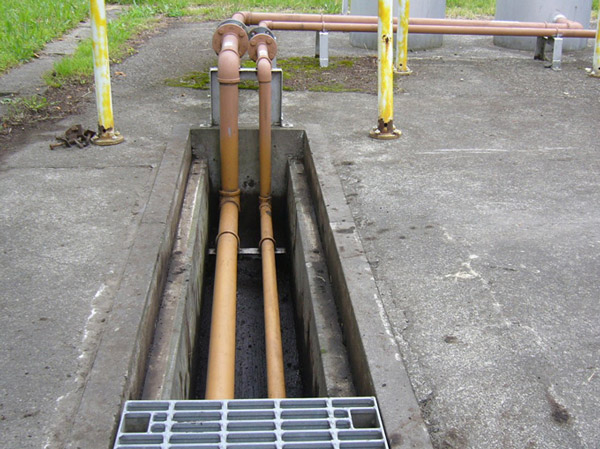
Visualization of Underground Piping (Installation in Concrete Troughs) (Katsuta Plant)

Scene from an emergency drill (Katsuta Plant)
Measurement data from each plant against legal limits (air quality, water quality, noise, vibration)
Measurement data from each plant compared to legal and regulatory limits (air quality, water quality, noise, vibration): In fiscal year 2024, none of our facilities exceeded legal or ordinance limits.
- There were also no exceedances of facility-specific standards (standards set for voluntary management at each facility).
Koki Holdings Co.,Ltd. Katsuta Plant
| Item | Unit | Legal/Ordinance Standards | Factory standard | Maximum Measured Value |
|---|---|---|---|---|
| NOx | ppm | ≦ 180 | ≦ 120 | 38 |
| Particulate Matter | g/m3 | ≦ 0.3 | ≦ 0.2 | < 0.01 |
| Item | Unit | Legal/Ordinance Standards | Facility Standard | Maximum Measured Value |
|---|---|---|---|---|
| Hydrogen ion concentration (pH) | - | Greater than 5 and less than 9 |
5.2~8.8 | 6.9~8.5 |
| Biochemical Oxygen Demand (BOD) | mg/L | < 600 | ≦ 200 | 1.0 |
| Suspended Solids (SS) | mg/L | < 600 | ≦ 200 | 2.0 |
| n-hexane-extractable substances (mineral oil) | mg/L | ≦ 5 | ≦ 1.7 | < 0.5 |
| n-Hexane-extractable substances (mineral oils) | mg/L | ≦ 30 | ≦ 10 | < 0.5 |
| Category | Unit | Legal/Ordinance Standards | Facility Standard | Maximum Measured Value |
|---|---|---|---|---|
| Daytime | dB | ≦ 75 | ≦ 75 | 49 |
Sankyo Diamond Industrial Co., Ltd. Nabari Plant
| Item | Unit | Legal/Ordinance Standards | Facility Standard | Maximum Measured Value |
|---|---|---|---|---|
| Hydrogen ion concentration (pH) | - | 5.8 or higher, 8.6 or lower |
6.0~8.4 | 7.1 |
| Biochemical Oxygen Demand (BOD) | mg/L | ≦ 160 | ≦ 20 | 3 |
| Suspended Solids (SS) | mg/L | < 200 | < 180 | 2.4 |
| n-Hexane extractable substances, mineral oil | mg/L | ≦ 5 | ≦ 4.5 | < 0.5 |
| n-Hexane extractable substances, animal and vegetable oils | mg/L | ≦ 30 | ≦ 27 | < 0.5 |
| Category | Unit | Legal/Ordinance Standards | Facility Standard | Maximum Measured Value |
|---|---|---|---|---|
| Daytime | dB | ≦ 70 | ≦ 70 | 61 |
| Category | Unit | Legal/Ordinance Standards | Facility Standard | Maximum Measured Value |
|---|---|---|---|---|
| Daytime | dB | ≦ 65 | ≦ 65 | 40 |